
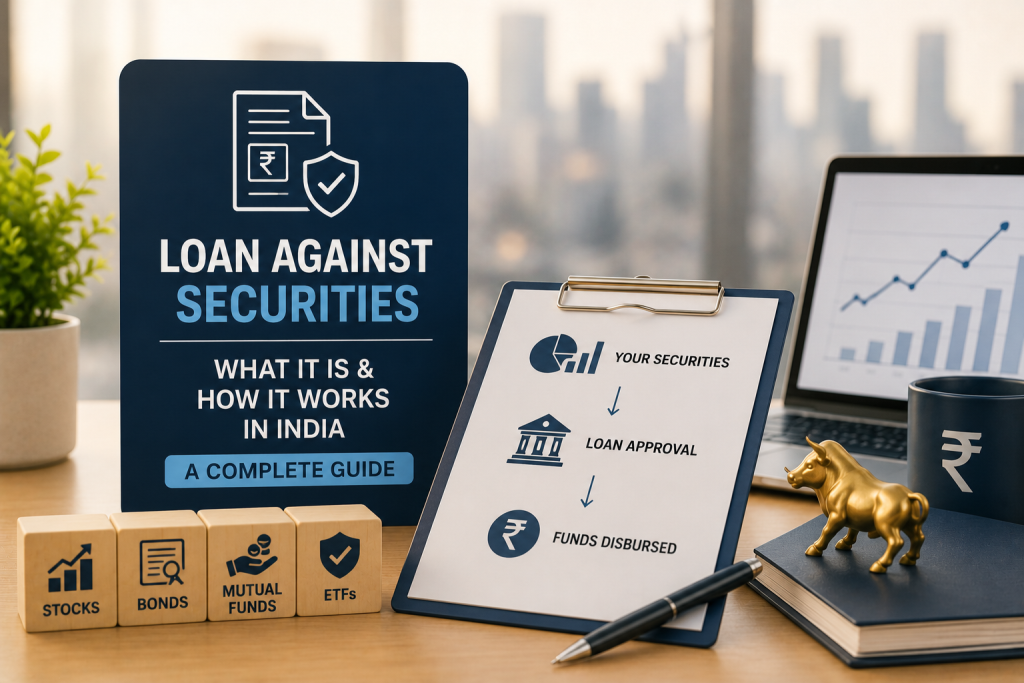
Many people invest in shares, mutual funds, bonds, or other financial instruments to grow their wealth. But what if you suddenly need money?
Most people think of selling their investments. But that’s not always the best option.
Instead of selling your investments and missing out on future growth, you can use them to raise funds. This is where a Loan Against Securities can help.
With LAS, you can pledge your investments as collateral and borrow money from a bank or NBFC, while still keeping ownership of those investments.
Let’s understand what a Loan Against Securities is and how it works in India.
A Loan Against Securities (LAS) is a secured loan where you pledge your financial investments to a lender in exchange for funds.
These investments can include shares, mutual funds, fixed-income securities, etc. The lender holds these securities as collateral until the loan is repaid. However, you continue to remain the owner of the investments. This means you can still benefit from dividends, interest, or long-term growth.
For example, if you take a loan against shares, your stocks remain in your name, but they are marked as pledged to the lender.
Because the loan is backed by financial assets, lenders consider it less risky. As a result, the interest rates are usually lower than those of unsecured loans like personal loans.
The process is relatively simple, but understanding each step will help you make better decisions.
You start by applying with a bank, NBFC, or LAS finance company. You provide details of the securities you want to pledge along with basic KYC documents.
Most lenders today offer a digital process, so you can apply online and get quick approvals.
The lender reviews the securities you are offering. They check:
Not all securities are accepted. Lenders usually have an approved list of stocks and mutual funds.
How much you can borrow is based on the Loan-to-Value (LTV) ratio. In simple terms, this means you cannot borrow the full value of your investments.
Loan amounts usually start from around 50% of the security value, depending on the type of investment and your credit profile.
Once your securities are approved, the lender assigns you a loan limit instead of giving a fixed amount upfront.
You can take out money whenever required, as long as it’s within the limit, making it quite flexible, like an overdraft.
You can repay your loan as per the terms discussed in your agreement.
Once the full amount is cleared, the lender removes the lien, and your securities are fully released.
Here are some key benefits you must know about Loan Against Securities in India:
Loan approval and disbursal can be very fast, often within 24 hours, making it useful during urgent financial needs.
Interest rates are usually lower than unsecured loans, starting from around 10.5% per annum, depending on the lender and profile.
You can borrow a significant amount, sometimes up to 85% of your portfolio value, depending on the type of securities.
The process is simple and requires only basic documents like KYC details and information about the securities being pledged. This makes the application quick and hassle-free.
A Loan Against Securities works like an overdraft, where your investments act as collateral.
You can withdraw funds as needed and pay interest only on the amount you use, not the full limit.
The eligibility for this loan is quite simple and mainly depends on your investments and basic financial details.
You should be an Indian resident and typically between 18 and 70 years of age.
You need to have a valid demat account with eligible shares or securities in your name.
Both salaried and self-employed individuals can apply, but lenders may ask for basic income proof.
The securities you pledge should meet the minimum value required by the lender.
You must provide a PAN card along with valid identity and address proof.
If you have your documents in place, the application process becomes much smoother. Here are the essential documents usually required:
A duly filled and signed loan application form as per the lender’s guidelines.
Basic documents like PAN card, identity proof, and address proof are mandatory.
Depending on your profile, you may need to provide salary slips, bank statements, or business income proof.
A statement showing your holdings in eligible shares or securities.
Some lenders may require additional forms or declarations as part of the process.
A Loan Against Securities helps you unlock funds while keeping your investments intact. It offers flexibility, lower interest rates, and lets you stay invested while meeting short-term financial needs.
Just make sure you understand the terms and are comfortable with repayment.
Infina Finance Private Limited, an RBI-registered NBFC, also offers Loan Against Securities solutions with a smooth and flexible process. If you’re considering this option, Infina can help you explore suitable loan options based on your investment profile and financial needs.
It is a secured loan, as your shares, mutual funds, or other investments are pledged as collateral. This reduces the lender’s risk and is why interest rates are usually lower than unsecured loans.
The loan amount generally starts from around 50% of the value of your securities. It can vary based on the type of investment, its market value, and your overall credit profile.
You can apply through a bank or NBFC by submitting basic KYC documents and details of the securities you want to pledge. Many lenders also offer an online application process for faster approval.
Yes, you continue to earn returns such as dividends, interest, or capital appreciation. Even though the securities are pledged, ownership remains with you.
It can be more cost-effective because interest rates are usually lower due to the secured nature of the loan. However, it depends more on your financial needs, risk appetite, and comfort with pledging your investments.
Yes. NRIs can pledge eligible Indian securities, subject to end-use conditions on home and vehicle purchases.
Yes, the funds can be used only for the purchase of a home or a vehicle. Any other use, such as business needs or fresh market investments, is not permitted.
Yes, all three roles are open to an NRI. But the loan can be sanctioned only for the purchase of a home or vehicle, not for any other requirement.









.svg)